
Improving a legal duty scheduling application
Feature updates and fixes for an existing application that manages duty schedules and case records.
- My role
- Feature development and maintenance
- Period
- 2021–2023
Context and objective
During a work-study placement, I maintained and extended an application already used to schedule legal duty shifts and track cases. The work focused on changes requested by users and continuity of the existing system.
An existing application had to keep managing duty schedules, calendars and cases while applying bar associations’ rules on rotations, waiting periods and fair allocation.
Deliver new features and fixes while keeping the existing business rules intact.
My contribution
I analysed requests, developed updates, fixed issues, documented changes and validated them with users.
The solution
Updates covered duty applications, shift swaps, schedules, case records, incident follow-up and allocation rules.
- Duty shifts and applications
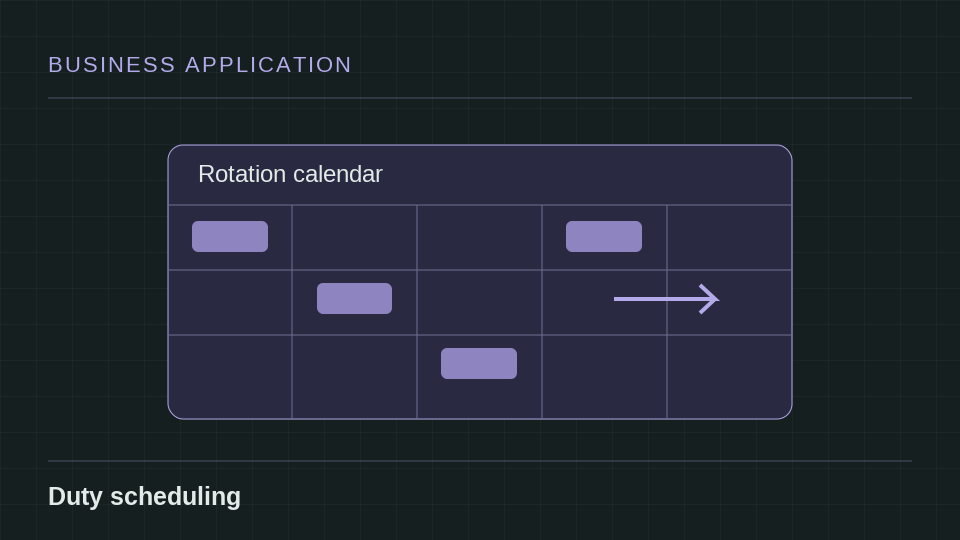
- Calendars and rotations
- Shift swaps
- Cases and incidents
- Waiting periods and fair allocation
How it works
- Submit applications for duty shifts
- Schedule rotations and manage swaps
- Track the associated cases
Outcome
Improvements delivered on an existing application
The work improved existing workflows and fixed defects, helping the teams continue using an application already in service.
Technical details
- C#
- ASP.NET MVC
- SQL Server
- ADO.NET
- Razor
Technical choices
C#, ASP.NET MVC, SQL Server, ADO.NET and Razor. The work covered requirements, duty rules, fixes and documentation, with particular attention to rotations, minimum gaps between assignments and fair allocation.
Key challenge
Make changes to an older codebase without losing rules where reliability and fair allocation matter.
Completed during a work-study placement. The application, organisations and data have been anonymised.
Your project
Could this help your business?
Tell me what you want to build or improve.